Wednesday, April 11, 2012

The White Lion ... and beyond!

The White Lion at Barthomley.
Great place for lunch, the White Lion at Barthomley.  Not your normal pub, this lovely old thatched public house dates back to 1614 and sits in the gorgeous little village of Barthomley.  Very picturesque and the food was wonderful.  Just to add to this "oldy worldy" look there was a delightful Morris Eight parked opposite.  Beautifully restored and a perfect vehicle for touring these quaint English villages.
Morris Eight at Barthomley.
The third shot in this post is a shot of the Morris as I imagined I might see in some Morris advertising brochure.  I was very impressed with the lovely honeycomb grill pattern.  Lovely detail in the old car.
The Morris Eight.  I love the honeycomb pattern to the grill.  White Lion in the background.
After a sumptuous lunch we headed off to Biddulph Grange.  These lovely gardens are quite special and are home to some lovely plants collected by one of Charles Darwin's contemporaries, James Bateman.  Talk of coincidences, James Bateman was born in Bury (perhaps you can recall an earlier post where I showed images of Robert Peel).  James Bateman was an expert and collector of orchids and his magnificent house still stands in its wonderful grounds today ... complete with tea-rooms and gift shop!
Biddulph Grange.


Monday, April 9, 2012

Hall i' th' Wood

Hall i' th' Wood
This 16th century building was only a short walk from my school, Canon Slade Grammar School, yet I never visited the hall until yesterday.  For a 13 year old boy, fish and chips were much more appealing than a Grade 1 listed building from the 1500s.  Both the "chippy" and the hall were about the same walking distance from the school, but the chips always won out in the seven years I was at Canon Slade.

Samuel Crompton was one of the more famous inhabitants of the hall and it is here that he both designed and built the first Spinning Mule.  Crompton's mule was quite basic in comparison to its derivatives that were developed in the 1800s yet produced a strong, thin yarn suitable for most types of textiles from its 48 spindles.  Amazingly, at the peak of the cotton industry in Lancashire there was in excess of 50,000,000 spindles.  With 1320 spindles per mule and about 60 mules per mill you can appreciate just how many cotton mills existed in Lancashire alone.  The mule, incidentally, was the most common form of spinning machine from about 1790 through to 1900.

Samuel Crompton's birthplace  at Firwood Fold
Samuel Crompton was born in 1753 at 10 Firwood Fold Bolton.  Samuel's father died whilst Samuel was still a young boy and this required Samuel to earn money to support the family.  Samuel earned money spinning yarns after his father's death but was convinced there was a better way to do the task.  He toiled away for several years before he came up with his invention, which, sadly, he had insufficient funds to patent.  Various promises were made and broken and in the end Samuel Crompton died in poverty even though it was his invention that really helped Lancashire become the dominant textile producer in the world.

Very easy to find, both Hall i' th' Wood and Firwood Fold and well worth a visit if you have time.
Samuel Crompton's birthplace to the left, the schoolhouse to the right.  Lovely old cobbled street at Firwood Fold.

Thursday, April 5, 2012

A bit of a treat!

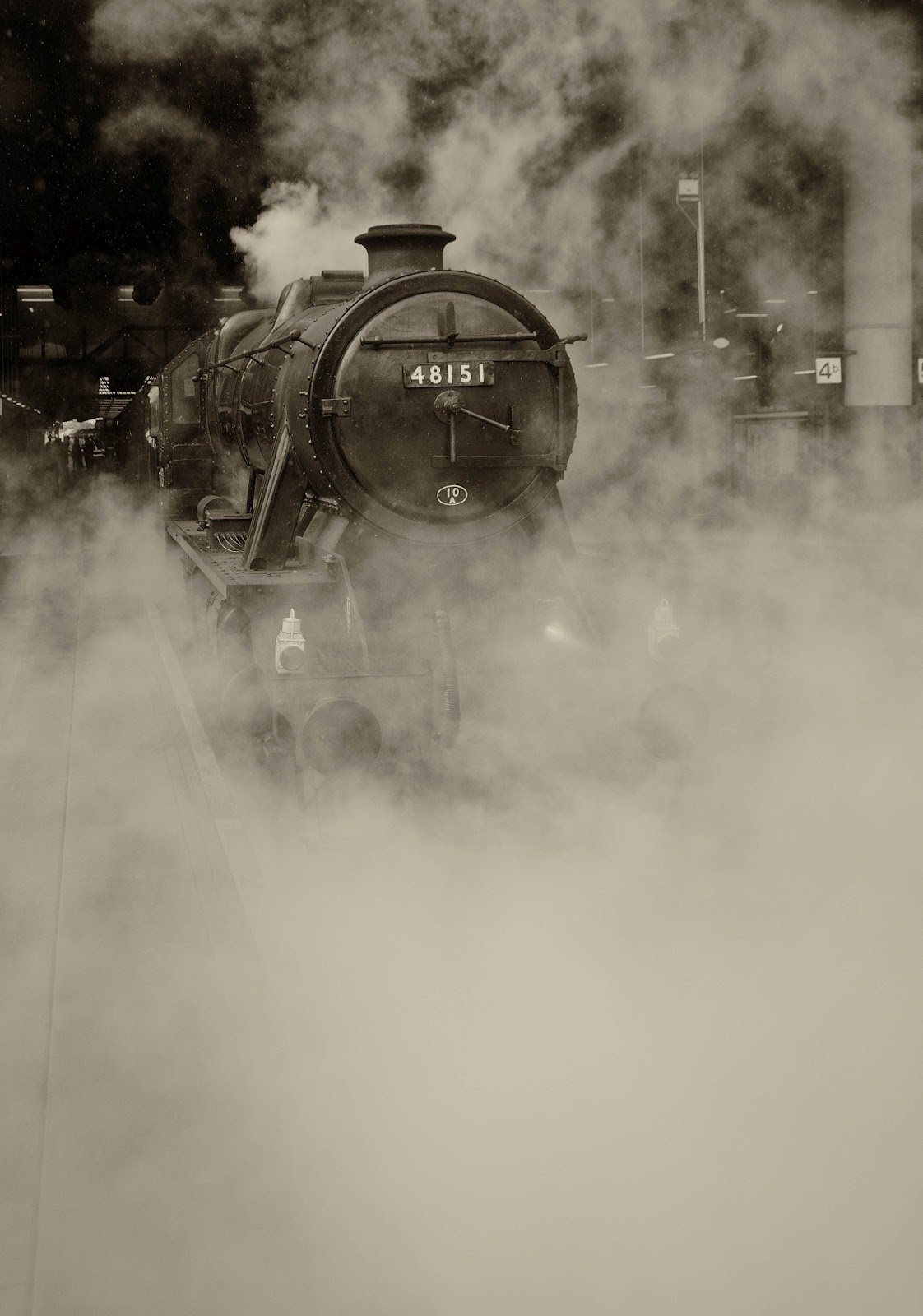
What a surprise!  I took the train into Manchester as I wanted to have a look around the town hall again.  Leaving the train and heading over the overbridge I couldn't help but notice the dirty windows looking over the tracks below and thinking how it reminded me of the days of steam.  There was I reminiscing of the days of steam when lo and behold in steams Stanier 8F 48151 on an enthusiasts special heading for York.  I couldn't believe it!  What a wonderful surprise!  Talk about being at the right place at the right time.

Not usually associated with passenger trains, the 8F was a stalwart of the LMS freight workings, but freight or passenger, 48151 looked stunning simmering away at the end of Manchester Victoria's Platform 3.

Even though it was bitterly cold with rain and sleet I still managed a few shots that I'll share with you here.  All converted to monochrome ... well ... what else for moody shots of steam engines?


Monday, April 2, 2012

Views from Victoria

Here's a few shots taken at Victoria Railway Station in Manchester whilst I waited for my train.  Some quite good views are afforded from the footbridges across the railway lines.  Please click on the images to get a larger and more detailed view ... they look a little "pixelated" in the post and seem much better when they've been enlarged.  Perhaps leave me a message and let me know what you think?
Looking towards Machester's cathedral with Chethams School of Music on the left.

Impressive ironwork facades to the railway bridges as the bridge the gap into the station.

Old and new.  The Arndale Centre, Chethams School of Music and Manchester's wheel.

7 shot HDR image looking away from the station.

Hmmm.  Is that my train?

Spring daffodils

Wow!  What glorious light this afternoon.  I took a short walk in Hall Lee Bank Park to see if the bluebells were out, and, sorry to say, they're not.  No bluebells, but the daffodils were out and the light was quite special.  Anyway, I couldn't resist sharing these two photos from my walk earlier today.  I hope you enjoy them ... perhaps let me know what you think?


Both shots taken at 85mm and f2.8 in an attempt to blur the background, but keep the flower sharp.  Of the two shots I think I prefer the first.  A dreamier shot than the second.  Maybe let me know which you prefer?

A trip to Bury ...

Statue in memory of Robert Peel in front of the Parish Church, Bury
It's been a very long time since I visited Bury ... a very long time.  I used to live near Bury and this was the town we'd often visit to do our weekly shopping.  It was also the town we'd head to in order to catch the train into Manchester if there was anything special we needed to buy.  However, after moving to Bolton in the late 1970s, visits to Bury became less frequent.  There was a brief burst of visits when I worked at Peel College in the early 1980s, but I didn't really go into the town.  Just commuted to the college really.

So, with a desire to look again at what was once quite a pleasant town I took the train into Manchester and then the tram from Manchester's Victoria station into Bury.  The train pretty well took the same route as the train took when I was much younger.  A few of the stations have changed from the days of the old electric trains, and there seemed rather more rubbish and waste scattered around the area.  Similar to how I remember the area, but rather more different than I was expecting.

On arrival at Bury it seemed less welcoming than I could recall.  Kay Gardens is a shadow of its former glory and the area just seemed somewhat dirty and run down.  I headed off towards the Parish Church as I wanted to see the barracks and the statue of Sir Robert Peel.
Sir Robert Peel.
Robert Peel is one of the more famous people born in Bury.  Whilst Home Secretary Robert Peel helped create the modern concept of the police force.  Named after Robert Peel the new police officers the new "Bobbies" or "Peelers" were the forerunners of the familiar police officers of today.

Subsequent to Robert Peel's sudden death a public meeting in Bury's court house determined that a monument be erected as a perpetual memorial to the town's eminent townsman.

A Bury local told me that  the sculptor of the bronze statue, Edward Hodges Baily, committed suicide when he noticed the mistake in his statue.  Take a look at the image of Sir Robert Peel and see if you can see the mistake.  I'll tell you what the mistake is at the end of this post.  Not sure the story of suicide is correct, bit the mistake is definitely there.

Close by the statue of Sir Robert Peel and the Parish Church you'll find the barracks.    This building is quite impressive and probably not noticed by many of Bury's visitors being hidden away behind the main streets.  The third shot in this post is a four shot panorama stitched together which may explain the slight distortion in the building, but at least it gives you an impression of the building.
The barracks at Bury.
No town of significance in the Victorian era was without a railway, and Bury was no exception.  Bury had two stations and a signifiant number of lines linking it with its neighbours.  In the 21st century the link to Manchester remains and the East Lanacashire Railway now runs steam and diesel trains to Heywood and Rawtenstall from Bury.  It's a good run and great fun.  I thoroughly enjoyed myself on the trains.  The next few shots were taken on the line ... converted to monochrome to give that expected 1940s/1950s look.  Click on the image to see a larger and clearer view of the shots an please let me know what you think.


Thought I'd forgotten to tell you the sculptor's mistake?  Not a chance.  The mistake is with Sir Robert Peel's waistcoat.  Men's clothes wrap left over right, ladies go right over left.  Look carefully at the image and you'll notice that Sir Robert's waistcoat is buttoned in a ladies style rather than a man's.

Sunday, April 1, 2012

Wheelton Locks

The "Top Lock Public House" at Wheelton Locks.
Just off the M61 there's a small village called Wheelton through which passes the Leeds Liverpool Canal.  The special thing about the place are the locks.  Sadly we didn't get to see them in action, but it's still a lovely place to visit nevertheless.  Being somewhat inspired by the sepia type photographs from the late 1800s and early 1900s I've converted my colour digital images into monochrome.  Perhaps let me know what you think?
Lock keepers cottage at the top lock at Wheelton.
Another lock keepers cottage and lock.